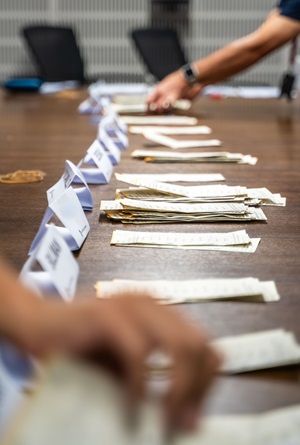
Counting votes in an election is a complex process. Accuracy is our highest priority.
We prepare detailed count plans to map the counting period for the Lower House (Legislative Assembly district elections) and the Upper House (Legislative Council region elections).
We have made several changes to our counting processes for this election. We will:
use rechecked figures for the 2-candidate-preferred (2CP) count, not just primary count figures
count all Upper House ballot papers at the centralised activity site (CAS)
hold a full distribution of preferences (to the last 2 candidates) for all Lower House districts, even when one candidate has already won more than half of the votes (an absolute majority)
publish more detailed counting results, such as which early voting centre the votes came from. This detail will be published on our website and through our results data feed.
We have also improved the design of our results web pages to make the user experience easier and more accessible for all.
Lower House count
Counting begins as soon as possible after voting closes at 6 pm on election day.
The four stages of the count
The Lower House uses a full preferential vote-counting system.
To make sure the result is accurate, we count the votes manually by hand in each district in 4 stages.
1. First preference count (primary count)
The first time we count a Lower House vote, we do a first preference count. This is called a primary count.
At each counting table, we sort ballot papers using a sorting card for each candidate.
After we examine each ballot paper, we place it next to:
the sorting card for the candidate who received the number '1' vote, if the vote is formal
the sorting card for possible informal votes, if the vote appears to be informal. We check it again before placing it with informal votes.
A formal vote is a ballot paper that is filled out correctly.
An informal vote is a ballot paper that has not been completed correctly.
After this sort, we tally the first-preference votes for each candidate and the informal votes. We enter these results into our election management system and publish all results on our website.
We follow the above process for each parcel of votes. A parcel might contain all votes cast at one voting centre. It might also contain a group of other votes admitted to the count, such as postal votes.
We continue until we have counted all votes for the Lower House.
It can take more than a week after election day to do the primary count for all parcels. This is because we need to wait for all votes to be received at the correct counting location. For example, we can receive postal votes up until 6 pm on the Friday after election day. Votes cast interstate and overseas also need to be returned to us.
The vote exchange
We transport the following votes to the CAS for processing and counting:
other-district votes taken at voting centres
all declaration votes.
We may also transport these votes to local election offices.
We call this process the vote exchange.
2. 2-candidate-preferred (2CP) count of likely leading candidates
Before election day, the Electoral Commissioner pre-selects 2 candidates who we expect will have the highest number of votes after preferences are distributed. This decision is based on the best available data using expert electoral knowledge, political science and data science.
The purpose of this count is to give an early indication of the possible election result in each district for election analysts, candidates, registered political parties and the media. It has no effect on the official outcome for the district.
The 2CP results in each district also provide an early indication of who may form government.
Before this 2CP count begins, we tell scrutineers who the 2 candidates are.
After we count the first preference votes for each parcel, we sort all formal ballot papers to those 2 selected candidates. We do this by looking at which candidate has the higher preferences on the ballot paper.
We enter these results into our election management system and publish all results on our website.
We will monitor the results of the 2CP count in each district. If our initial predictions seem incorrect, we might decide to change the 2 candidates of the 2CP count at the start of the recheck. Again, these 2CP counts are just a prediction.
In some circumstances we might consider a 3-candidate-preferred count at the start of the recheck, instead of a 2CP.
We do not change the 2CP candidates on election weekend. If our 2CP prediction seems incorrect, we may remove the 2CP results for the district from our website and results data feed. We may do this on election night or through the recheck period.
3. Recheck
Following a primary first-preference count, ballot papers are checked again for:
formality
correct sorting to first preference
correct totals.
Following the recheck, we do the 2CP count again to confirm the totals.
We enter these results into our election management system and publish all results on our website. Once published, these results replace the primary results.
4. Distribution of preferences
Based on recent trends, we expect that most districts will need a distribution of preferences to decide the outcome of the district.
But in 2026, we will do a distribution of preferences for all districts, even if there has been a winner on first-preference votes. This is to allow earlier analysis of the results and to confirm who the 2 candidates with the highest number of votes are. It also shows what the margin was between those 2 candidates.
If no candidate in the district has an absolute majority of formal votes (more than 50%) after all the first-preference votes have been counted and rechecked, we’ll distribute the preferences of the candidate with the lowest number of votes. This process will determine who has won the district election.
There are six steps for a preference distribution:
Exclude the candidate with the lowest number of votes.
Look at that candidate's votes.
Transfer each of their ballot papers to the candidate that is the voter's second preference
If no candidate has an absolute majority after this transfer, exclude the candidate with the next fewest votes.
Transfer that candidate's votes to the remaining candidates based on the voter’s next preference. If the second-preferenced candidate has already been excluded, then the third preference is considered, and so on.
Continue this process until the final 2 candidates are identified and the one who reached absolute majority is announced as the successful candidate.
For example, if there are 20,000 formal votes in the count, the winner needs 10,001 votes.
We enter the distribution of preferences for each district into our election management system and publish them on our website.
For the Lower House of State Parliament, and many local councils where you’re electing one councillor for your ward, the preferential voting system is used to count votes. This means that to be elected, a candidate must achieve an absolute majority of the total number of formal votes. In other words – more than 50% of the total formal votes.
For example, if 20,000 votes are cast, the winner needs 10,001 votes.
The votes are allocated to each candidate based on the voter’s first preference – or where they have put the number one. After they have all been sorted, the number of votes for each candidate is counted. If no candidate has achieved an absolute majority (more than 50% ), a preference distribution is conducted.
To do this, the candidate with the lowest number of votes is excluded. The excluded candidate’s votes are inspected and allocated to the next preferred candidate - or where the voter has put the number two. After this, the totals are counted again. If there is still no absolute majority, the next lowest scoring candidate is excluded and, again, their votes are redistributed to where the voter placed the number two. If the second preferenced candidate has already been excluded, then the third preference is considered, and so on.
This process is continued until one candidate receives an absolute majority of votes and is elected.
So, make sure you have really thought about your preferences, because around half of the Lower House and council electorates are won on preferences!
For further information, visit vec.vic.gov.au or call 131 832.
Upper House count
We use proportional representation to count votes in the Upper House. You can choose to vote above or below the line on the Upper House ballot paper.
Each region elects 5 members. To be elected, a candidate must get a certain number of formal votes. This is called a quota.
Proportional representation is a way of counting votes in an election when there is more than one candidate to be elected.
The principle of proportional representation is that candidates are elected in proportion to their support from voters.
In Victoria, we have proportional representation to elect members of the State's Upper House and many local councils.
How do you vote?
You rank the candidates in the order you decide. Your preferences are vital in deciding who gets elected.
To be elected, a candidate needs to get a proportion of votes, called the 'quota'. The quota varies according to the number of candidates to be elected. As an example, with three candidates to be elected and 140 votes, the quota is 36 votes.
Here are the first preference votes for the six candidates.
Belinda has more votes than the quota, and is elected.
Belinda's 'surplus' votes (the 12 votes over the quota) are distributed to the other candidates according to voters' preferences.
Belinda's surplus votes don't lead to any other candidate reaching a quota.
When you run out of surpluses, the candidate who now has the fewest votes (Emma) is excluded, and the votes for Emma go to the remaining candidates according to the voters' preferences.
This continues until all the places for that electorate are filled.
Remember, with proportional representation, your preferences really count.
For further information, visit vec.vic.gov.au or call 131 832.
How we calculate the quota
We calculate the quota by dividing the number of formal ballot papers by the number of candidates to be elected, plus one. We then add one to this figure.
For example, if there are 60,000 formal ballot papers and 5 members to elect:
60,000 ÷ (5 + 1) + 1 = 10,001
The quota would be 10,001 votes.
Group voting tickets have been removed
Changes to the Electoral Act mean group voting tickets have been removed from Upper House elections.
If you choose to complete your Upper House election ballot paper above the line, you are now instructed to number the boxes above the line from 1 to at least 5 in the order of your preference.
When you vote above the line, you choose groups of candidates instead of individual candidates. Your preferences are then given to individual candidates in each of your chosen groups in the order they appear on the ballot paper. Above-the-line group order is determined by a ballot draw, but groups choose how their candidates are ordered below the line.
How we count the votes
The first time an Upper House vote is counted, we do a first-preference count. This is known as a primary count.
At each counting table, we sort ballot papers using a sorting card for each group and ungrouped candidate. We then manually count and record:
the number of first preference votes for each group marked above the line
the number of first preference votes for each group and ungrouped candidate marked below the line.
During the sort to first preference, we also look for ballot papers that are obviously informal, such as ballot papers that are blank or have no number '1'.
We place these ballot papers at the informal sorting card and count them.
We enter these results into our election management system and publish all results on our website.
Counting votes in parcels
Like the Lower House primary count, we follow the above process for each parcel of votes. A parcel might contain all votes cast at one voting centre. It might also contain a group of other votes admitted to the count, such as postal votes.
We continue until we have counted all votes for the Upper House.
It can take over 10 days after election day to do the primary count for all parcels.
Data entry at the CAS
At the CAS these votes are then data entered (rechecked) twice in our computer count application. We data enter parcels of votes as soon as possible after being primary counted. The data entry process will detect any ballot papers that are informal, and all 'obviously' informal ballot papers from the primary count will be reviewed.
We publish the rechecked results on our website and in our results data feed after the first and second round of data entry. These results replace the primary results once published.
The distribution of preferences and results are then calculated using our computer count application.
Partial preferential voting and exhausted votes
A unique aspect of the Upper House is partial preferential voting.
This is different to the full preferential voting system used in the Lower House.
In the Upper House, you only need to preference up to 5 groups above the line or up to 5 candidates below the line on your ballot paper.
This means your vote may exhaust. A vote is considered exhausted when there are no more available preferences for any continuing candidate.
To put this another way, if all candidates that you preferenced are excluded from the count because they didn’t get enough votes, your vote will then be set aside from the count at that point. It will be shown as 'exhausted' in our distribution of preferences report.
Scrutineers
Candidates cannot watch the vote count. Instead, each candidate can appoint scrutineers to observe the count.
Scrutineers can challenge any ballot paper they think may have been sorted or counted incorrectly.
This does not apply to the 2CP count. The 2CP count gives an indication of the result (ballot papers are not checked for formality during these counts). During these 2CP counts, ballot papers we already consider formal in the preceding primary count or recheck are simply distributed to the 2 selected candidates.
Scrutineers can request certain reports during the data entry for Upper House votes and after the results in each region are calculated.
Read more about this in our Availability of results guide, which will be ready before election day.
At election day voting centres, we start the primary count and 2-candidate-preferred (2CP) count for ordinary votes from 6 pm. We also reconcile absent votes.
At hubs, we process own-district early votes by placing them face down in a restricted area. We do this on election day to prepare them for counting. We start the primary and 2CP counts of these votes from 6 pm. We also start preparing other-district early votes for dispatch in the early vote exchange.
At the CAS, preliminary scrutiny of postal votes continues. This begins on 17 November once postal votes start being received. On election day, we also start extracting postal votes by placing them face down in a restricted area to prepare them for counting. We start the primary and 2CP counts of these votes from 6 pm.
Region elections (Upper House)
At election day voting centres, we count or reconcile ordinary votes. We also reconcile absent votes.
At hubs, we process early own-district votes to prepare them for dispatch to the CAS.
At the CAS, preliminary scrutiny of postal votes continues. We also start extracting postal votes by placing them face down in a restricted area to prepare the region ballot papers for counting on Sunday.
We continue primary and 2CP counts for early own-district votes. We also start to exchange other-district votes locally within hubs.
We continue to prepare all remaining other-district early votes, as well as votes in declaration envelopes, for dispatch to CAS. This is the early vote exchange.
At the CAS, we start receiving telephone votes and deliveries of early votes from interstate and overseas voting venues.
We continue extracting postal votes and doing the primary and 2CP counts.
Region elections (Upper House)
At hubs, we dispatch ordinary election day votes to the CAS. At the CAS, we receive and begin to batch the counted votes for data entry.
At hubs, we also send early own-district votes to the CAS. We also prepare other-district early votes for dispatch in the early vote exchange.
At the CAS, we start counting and batching postal votes that were extracted on election day. We also begin to extract and count new postal votes.
At the CAS, we receive ordinary election day votes and own-district early votes.
We also receive telephone votes and begin to receive deliveries of early votes from interstate and overseas voting venues.
At hubs, we dispatch the early vote exchange to the CAS and begin the recheck then recheck 2CP of ordinary election-day votes.
We also start preparing the vote exchange for absent votes.
We begin the recheck then recheck 2CP of early own-district votes. We also count and recheck locally received other-district votes.
At the CAS, we continue postal vote preliminary scrutiny and recheck then recheck 2CP of postal votes that were primary counted on election weekend.
We also receive and start processing the early vote exchange and start checking provisional votes.
We do the primary count, recheck then recheck 2CP for telephone votes.
Deliveries of early votes from interstate and overseas voting venues continue through to 6 December.
Region elections (Upper House)
We complete the batching of ordinary election day votes and begin the primary count and batching of reconciled ordinary votes (ordinary votes that weren’t counted in election day voting centres).
Hubs dispatch the early vote exchange and start preparing the vote exchange for absent votes. The CAS receives and starts processing the early vote exchange.
We continue preliminary scrutiny of postal votes at the CAS and continue this through to 4 December.
We continue to extract, count and batch postal votes, and receive interstate and overseas early votes.
We also start and complete the counting and batching of telephone votes.
We begin checking provisional votes and this continues until 6 December.
Computer count data entry of all batched parcels starts at the CAS and continues until 15 December.
At hubs, rechecking continues for ordinary election day votes and early own-district votes, and the absent-vote exchange is dispatched to CAS.
At the CAS, we start receiving absent-vote exchanges and continue to process the vote exchange for early other-district and declaration votes.
Postal vote preliminary scrutiny continues. We continue postal vote extractions, primary counts and rechecks then rechecks of 2CP.
Provisional vote checking continues. Deliveries of early votes from interstate and overseas voting venues continue through to 6 December.
Region elections (Upper House)
We continue primary counting and batching of ordinary election day votes that were not counted on election night.
At the CAS, we start receiving the absent-vote exchange and continue to process the vote exchange for early other-district and declaration votes.
We also start the primary count and batching of early own-district votes.
We continue preliminary scrutiny of postal votes at the CAS and continue this through to 4 December.
We continue to extract, count and batch postal votes; continue with provisional vote checking; receive interstate and overseas early votes; and continue computer count data entry.
At hubs, we continue rechecks of ordinary and own-district early votes.
At the CAS, we continue processing the absent-vote exchange.
We also primary count, recheck then recheck 2CP of other-district early votes from the early vote exchange.
We continue preliminary scrutiny of postal votes. We also continue to extract, count and recheck postal votes.
Provisional vote checking continues. We start preliminary scrutiny of marked-as-voted and provisional votes which continues through to 6 December.
Deliveries of early votes from interstate and overseas voting venues continue through to 6 December.
Region elections (Upper House)
At the CAS, we are due to complete the primary count and batch of reconciled election day ordinary votes and complete vote exchange processing for absent votes.
We continue the primary count and batching of early own-district votes.
We continue preliminary scrutiny, extract, count and batch of postal votes.
Provisional vote checking continues.
We start preliminary scrutiny of marked-as-voted and provisional votes, and this continues until 6 December.
Deliveries of early votes from interstate and overseas voting venues continue through to 6 December.
In hubs, we are due to complete rechecks of ordinary election day votes and early own-district votes.
At the CAS, we primary count, recheck and recheck 2CP the absent votes from the absent vote exchange.
Postal vote preliminary scrutiny, extraction, counting and rechecking continues as do deliveries of early votes from interstate and overseas voting venues.
At the CAS, we continue: the primary count and batching of early own-district votes; preliminary scrutiny, extraction, counting and batching of postal votes; receiving interstate and overseas early votes; provisional vote checking; preliminary scrutiny of marked-as-voted and provisional votes; and computer count data entry.
At the CAS, we continue provisional vote checking, as well as preliminary scrutiny of marked-as-voted and provisional votes.
We are due to complete preliminary scrutiny of postal votes at the CAS.
Postal vote counting and rechecking continues as do deliveries of early votes from interstate and overseas voting venues.
Region elections (Upper House)
At the CAS, we are due to complete preliminary scrutiny of postal votes.
We also continue: primary count and batching of early own-district votes; extraction, counting and batching of postal votes; receipt of interstate and overseas early votes; provisional vote checking; preliminary scrutiny of marked-as-voted and provisional votes; and computer count data entry.
At the CAS, we continue postal vote extraction, counting and rechecking and continue to receive deliveries of early votes from interstate and overseas voting venues.
Provisional vote checking continues, as well as preliminary scrutiny of marked-as-voted and provisional votes.
Region elections (Upper House)
At the CAS, we continue: the primary count and batching of early own-district votes; extraction, counting and batching of postal votes; receipt of interstate and overseas early votes; provisional vote checking; preliminary scrutiny of marked-as-voted and provisional votes; and computer count data entry.
At the CAS, another period of primary count and recheck then recheck 2CP starts for any further absent votes and early other-district votes received after the bulk vote-exchange dispatches.
Also at the CAS, we begin the extract, count and recheck then recheck 2CP of interstate and overseas early votes and marked-as-voted and provisional votes.
Region elections (Upper House)
At the CAS, we continue the primary count and batching of early own-district votes.
We extract, primary count and batch interstate and overseas early votes.
We also extract, primary count and batch marked-as-voted and provisional votes.
In hubs, we are due to complete the receipt and amalgamation of vote parcels.
In hubs, we also begin declaration activity for any districts where a candidate had an absolute majority of first preference votes.
Region elections (Upper House)
At the CAS, we are due to complete the primary count and batching of early other-district votes received in the early vote exchange and the primary count and batching of early own-district votes.
We do the primary count and batching of absent votes received in the absent-vote exchange.